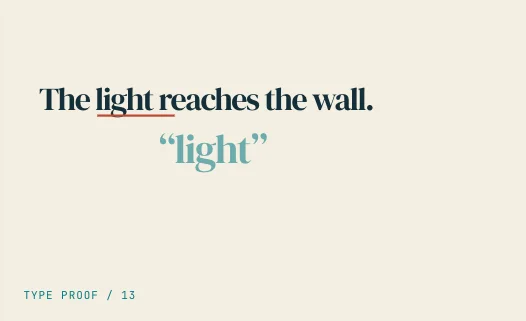
A marked phrase moves into the margin. Its original location stays underlined in the source text.
IN EVERYDAY WORDS
Lift the quotation. Compare the two ends of the control, then replay the change.
The look
A marked phrase moves into the margin. Its original location stays underlined in the source text.
Say this to a designer
Apply “Quote a marked phrase” to my caption or headline. A marked phrase moves into the margin. Its original location stays underlined in the source text.
Direct the motion
These are starting points, not fixed rules. Match the timing to the content and the person using it.
trigger
Scroll through the study or adjust “Lift the quotation” directly.
entrance
Begin with the identifiable state “Marked source”.
path
A marked phrase moves into the margin. Its original location stays underlined in the source text.
timing
Scrub to inspect the change, then use replay to see the sequence in time.
easing
Match the illustrated motion. Keep manual seeking directly coupled to the control.
hold
Hold the resolved state “Margin quotation” long enough to inspect its defining detail.
exit
Carry the subject into the next exhibit and keep the saved project selection.
The vocabulary
Text choreography
An arranged sequence changes which words draw attention and when they can be read.
Make it fit your project
Good places to use it: caption or headline.
Use this reference to recreate the change from “Marked source” to “Margin quotation”.
Watch for: Keep the primary subject and its original meaning recognizable throughout the change.
When motion is off: Select “Marked source” or “Margin quotation” to inspect a still state. The same control works from the keyboard.
Implementation and accessibility
Use “Lift the quotation” to move from “Marked source” to “Margin quotation”.
A marked phrase moves into the margin. Its original location stays underlined in the source text.
Check the beginning, midpoint and end at phone size. Replay the result and reverse the control.
Give the control a persistent name. Provide both endpoint descriptions and a keyboard equivalent.
Mount the active study on demand and release it after the visitor leaves.
Replace [ELEMENT] with the part of your project you want to change. The prompt includes the design brief, motion direction, definitions, and implementation steps.
Read the full prompt
Use AI Acceleration Design Ref #419 (Quote a marked phrase, version 1) on [ELEMENT] in my existing project.

Permanent reference: https://aiacceleration.ai/designrefs/419. This local brief contains the full definition. Inspect my existing stack, component, design tokens and interaction before editing.

Goal: A marked phrase moves into the margin. Its original location stays underlined in the source text.

DESIGN REF #419 · Quote a marked phrase

In everyday words: Lift the quotation. Compare the two ends of the control, then replay the change.

The look: A marked phrase moves into the margin. Its original location stays underlined in the source text.

Say this to a designer:
Apply “Quote a marked phrase” to my caption or headline. A marked phrase moves into the margin. Its original location stays underlined in the source text.

Motion direction (starting points to adapt):
Trigger: Scroll through the study or adjust “Lift the quotation” directly.
Entrance: Begin with the identifiable state “Marked source”.
Path: A marked phrase moves into the margin. Its original location stays underlined in the source text.
Timing: Scrub to inspect the change, then use replay to see the sequence in time.
Easing: Match the illustrated motion. Keep manual seeking directly coupled to the control.
Hold: Hold the resolved state “Margin quotation” long enough to inspect its defining detail.
Exit: Carry the subject into the next exhibit and keep the saved project selection.

Design vocabulary:
Text choreography: An arranged sequence changes which words draw attention and when they can be read.

Reduced motion: Select “Marked source” or “Margin quotation” to inspect a still state. The same control works from the keyboard.

Implement:
1. Use “Lift the quotation” to move from “Marked source” to “Margin quotation”.
2. A marked phrase moves into the margin. Its original location stays underlined in the source text.
3. Check the beginning, midpoint and end at phone size. Replay the result and reverse the control.

Adapt the reference to my branding and content. Preserve existing functionality and semantic HTML.
Reduced motion: Select “Marked source” or “Margin quotation” to inspect a still state. The same control works from the keyboard.
Accessibility: Give the control a persistent name. Provide both endpoint descriptions and a keyboard equivalent.
Performance: Mount the active study on demand and release it after the visitor leaves.
Avoid: Keep the primary subject and its original meaning recognizable throughout the change.

Show me the working result, verify keyboard, mobile, loading/error and reduced-motion behavior, and explain any tradeoff. Do not publish or change unrelated elements.
Permanent reference #419 · version 1. Pairs with #002, #004.