August 12 full-day workshop · Ryan Wanner
How do I join useful context, a checked draft and a working process?
Select the current cards a task actually needs, draft from verified facts, and inspect the result before acting. Then map the handoffs, owner and fallback for one repeatable job. A saved context card needs review when its facts change.
All classes1 / 3 · Manage the Seams
Each class was taught live by Ryan Wanner to working real estate agents.
Meaning has to cross the handoff
What must the next person receive?
Start with a listing explanation made from verified fictional property facts. Select the context it needs, then describe the review handoff. A finished draft is one state in the process.
Use fictional practice inputs. Copy your notes before leaving.
Work through one complete loop
Define finished
Choose one listing explanation to draft. Name the reader, the output and the factual error that would make you reject it.
Extract voice
Run the voice-extraction request on three permitted samples of your own writing. Check each observation against a quoted example, then save the useful habits in a SELF card.
Assemble context
Create a property-facts card from fictional verified inputs. Add the relevant review requirements and a source date. Keep unknowns separate from facts approved for the draft.
Make and inspect
Use SELF, GUARDRAILS and the property-facts card with the listing-description request. Read the entire result, compare its claims with the sources and mark one correction.
Work one bottleneck
Choose a bounded workflow problem. Work through Analyze, Research and Audit before asking for three possible next moves and their tradeoffs.
Close the loop
Map the chosen handoff: input, responsible person, output, acceptance check and fallback. Take an authorized reversible action or record the approval needed, then set the next review date.
The cards have different jobs
SELF: voice from your own writing
A small set of observed writing habits, with examples.
Name or harmless practice ID:
Source samples and date:
Tone, supported by an example:
Sentence rhythm, supported by an example:
Phrases I actually use:
Words I avoid:
How I open and close:
Review trigger: a repeated mismatch or a changed business fact.
Use permitted writing with identifying details removed. Run the voice-extraction recipe, then inspect each observation.
GUARDRAILS: the review requirements
Instructions guide a draft; they do not prove the draft passed.
Task and permitted use:
Required source facts:
Missing facts the model must ask about:
Brokerage or professional review needed:
Prohibited claims and unsupported predictions:
Describe property features, not the kind of person who should live there.
Keep confidential material out of model inputs.
Reviewer and acceptance check:
Review date and trigger:
This is a working checklist, not complete legal guidance. Check applicable requirements with the appropriate professional.
HOME: a dated property-facts file
Each permitted fact has a source; unknowns stay visible.
Fictional practice property ID:
Verified fact | Source | Source date | Checked by:
Property features approved for this task:
Unknowns to ask about or omit:
Review date and trigger:
Keep seller confidences, negotiation details and sensitive source records outside the model input. A DO NOT SHARE label is not protection after uploading. HOME is the name of this property file, not a prompting acronym.
CLIENT: relevant stated preferences
Only the permitted details needed for this task.
Harmless practice ID:
Question the person asked:
Stated priorities, in their words:
Relevant permitted constraints:
Communication preference:
Source and date:
Unknowns:
Review trigger:
Use fictional data for practice. Initials alone do not anonymize a person. Do not include confidences, protected traits or unnecessary private financial detail.
PERSONA: an audience hypothesis to check
Describe a task or need, with evidence and uncertainty.
Reader task or question:
Evidence that this need exists:
Known facts:
Assumptions to test:
Words actually used in permitted examples:
Helpful evidence or process explanation:
What would disconfirm this hypothesis:
Date to review:
Do not infer an individual’s finances, protected traits or housing intentions from an audience label.
CHANNEL: requirements for this destination
Use current format constraints and observed results.
Destination and intended reader:
Job the content should do:
Current format requirements with source/date:
Owned examples and what was observed:
Length and accessibility checks:
Allowed next step:
Reviewer and exact release approval:
Next review date:
Do not assume a platform rewards or punishes a format without evidence. Keep draft, publication and response separate.
HOME is this workshop’s name for a property-facts card. Select current information relevant to the task. Keep confidential material outside model inputs.
Three reminders from the systems slides
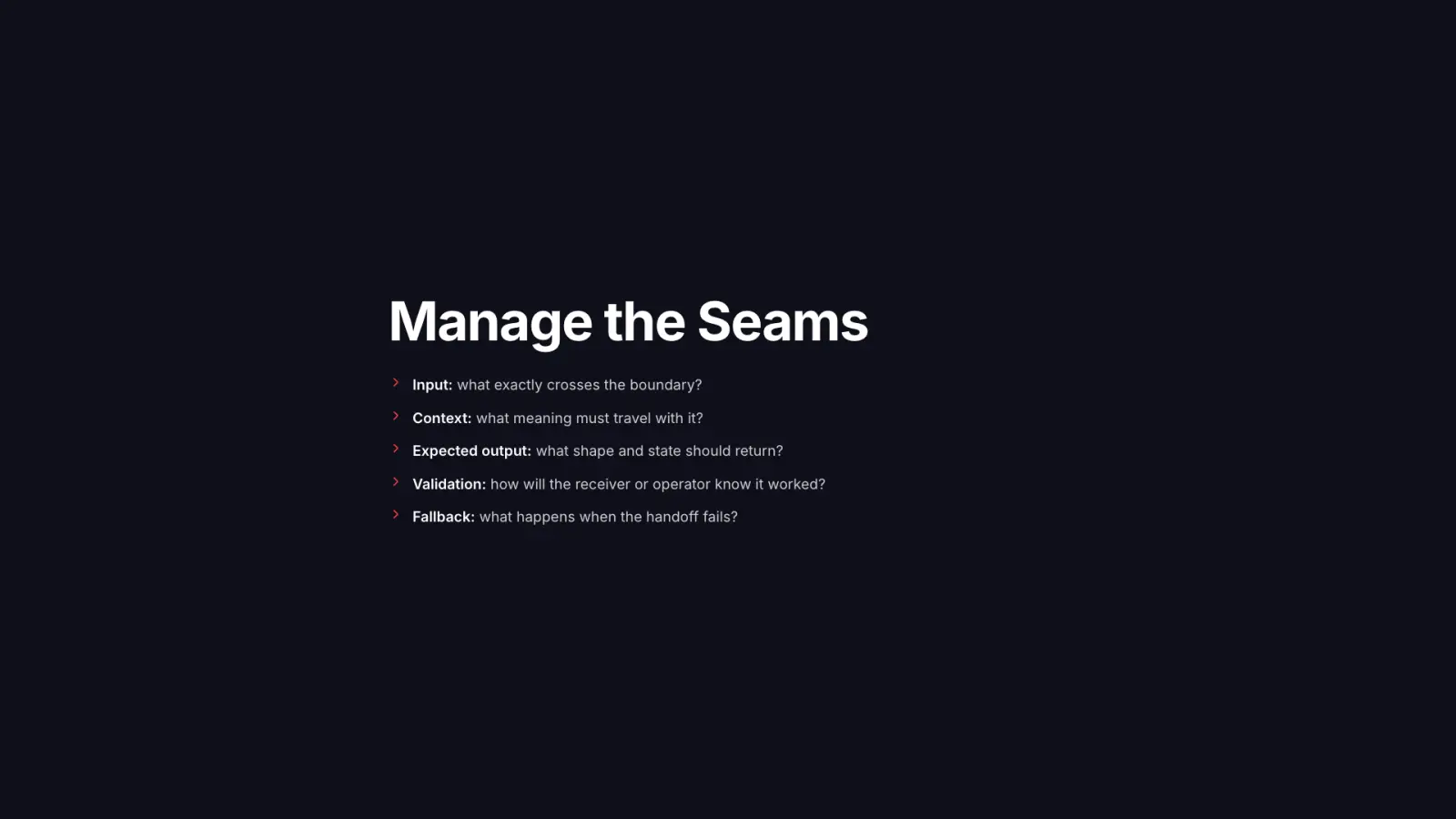
Fallback: what happens when the handoff fails?
Start with one observable task.
5 · Verify: a human or explicit rule checks the facts and controls delivery.
Treating the full kit as a required paste
Select the smallest current set of cards that helps this job. Leave confidential facts outside the prompt.
Confusing a rule with a completed check
A GUARDRAILS card asks for behavior. A person must still compare the resulting draft with sources and review requirements.
Ending the workflow at the draft
Name the next owner, acceptance check and fallback. Record pending approval honestly when that is the actual state.
Use the kit and its working requests
Create a free student portal account to download this class's files.
- Context Kits and AI Systems: The Full-Day Workshop working sheet
Current exercise, safe inputs, result checks and revision log.
- Context Kit working cards
Six current cards and voice extraction request.
- Business problem-solving request
Analyze, research, audit and choose one checked next action.
Open the full practice sheet
# Context Kits and AI Systems: The Full-Day Workshop

Current companion, prepared November 8, 2026, for the August 12, 2026 class. The exercises are editorial practice; no particular attendee outcome is claimed. No verified recording was located.

Select the current cards a task actually needs, draft from verified facts, and inspect the result before acting. Then map the handoffs, owner and fallback for one repeatable job. A saved context card needs review when its facts change.

## Define finished

Choose one listing explanation to draft. Name the reader, the output and the factual error that would make you reject it.

Check: State what would make you reject the result before generating it.

My input:
Observed result:
Correction and next action:

## Extract voice

Run the voice-extraction request on three permitted samples of your own writing. Check each observation against a quoted example, then save the useful habits in a SELF card.

Check: Each style observation points to supplied writing; no invented credentials or personality claims.

My input:
Observed result:
Correction and next action:

## Assemble context

Create a property-facts card from fictional verified inputs. Add the relevant review requirements and a source date. Keep unknowns separate from facts approved for the draft.

Check: Each property assertion has a source; unknowns stay unknown. Keep confidential source detail out of model input, rather than pasting secrets under “do not share.”

My input:
Observed result:
Correction and next action:

## Make and inspect

Use SELF, GUARDRAILS and the property-facts card with the listing-description request. Read the entire result, compare its claims with the sources and mark one correction.

Check: Compare every factual claim to the facts card, count requested length, inspect voice, remove unsourced additions.

My input:
Observed result:
Correction and next action:

## Work one bottleneck

Choose a bounded workflow problem. Work through Analyze, Research and Audit before asking for three possible next moves and their tradeoffs.

Check: Answer the three information questions first; do not accept invented operational data.

My input:
Observed result:
Correction and next action:

## Close the loop

Map the chosen handoff: input, responsible person, output, acceptance check and fallback. Take an authorized reversible action or record the approval needed, then set the next review date.

Check: Separate proposed action, action taken and outcome observed. Update changed cards and retest the relevant draft.

My input:
Observed result:
Correction and next action:

## Save the working record
Source, owner and date:
Exact version:
What passed:
What failed or remains unknown:
Permission needed before external use:
Next review date:
Work one bounded example
Using my current SELF, GUARDRAILS and property-facts cards, draft one listing explanation. List the sources, verified facts and unknowns first. Do not invent features, prices or claims. After the draft, compare every material statement with its source and identify one correction. Then map one repeatable handoff: input, responsible person, output, acceptance check, failure fallback and next observation. Stop at a draft or approval request; never claim an external action happened without a readback.
- Source-supported draft and visible unknowns
- Acceptance checks with actual results
- A correction and a saved working record
The Stacking Move — listing description from three cards
Here is my SELF card, my GUARDRAILS card, and my HOME card.

Using all three, write a listing description for this property.

Rules:
1. Every fact comes from the HOME card. If a fact is missing, ask me. Do not invent it.
2. The voice comes from the SELF card.
3. Nothing in the output may violate the GUARDRAILS card.

Then list anything you were unsure about, so I can check it.
- Facts only from the HOME card, voice only from the SELF card.
- Ends with an unsure-about list you check before using anything.
- Swap the deliverable line for a caption, email, or promo. Check the actual output against the supplied facts.
Channel-native caption from the same cards
Here are my SELF, GUARDRAILS, HOME, and CHANNEL cards.

Write a caption for this listing for the channel described in the CHANNEL card. Follow its format rules exactly. Facts only from the HOME card. Voice from the SELF card. Nothing that violates GUARDRAILS.

Then list anything you were unsure about.
- Length and hook style come from the CHANNEL card, not from the model's habits.
- Same facts, different channel: nothing new gets invented in translation.
The 6-step Problem-Solving Loop (OODA)
I want to solve a real business problem using OODA plus a structured AI process.

PROBLEM:
[describe the problem]

BUSINESS CONTEXT:
[who this affects, what is at stake, what constraints matter]

Use OODA as the frame: Observe, Orient, Decide, Act. Inside that frame, run this process with me:

1. ANALYZE
Restate the real problem in one sentence. Identify the owner, the win condition, and what might be getting confused.

2. RESEARCH
List what information is needed before recommending anything. Separate known facts from missing facts. Ask me the 3 most useful questions first.

3. AUDIT
Check assumptions, weak evidence, risks, and places your answer could be wrong. Tell me what must be verified.

4. CREATE
Give me 3 possible next moves: safest, fastest, and highest-upside. Include tradeoffs.

5. IMPLEMENT
Propose one reversible action and identify any approval needed. Do not perform an external action without authorization.

6. ITERATE
Tell me what result to watch for, what to measure, and how we should adjust on the next pass.

Do not jump to advice before completing Analyze, Research, and Audit.
- The problem is real, yours, bounded, and decidable today.
- Answer the three Research questions honestly. That exchange is where the value shows up.
- End with an observed action or a documented approval request, the responsible person and the next check.
Extract voice from three owned samples
Analyze these three permitted, redacted samples of my own writing. Describe typical sentence length, rhythm, signature phrases, words I use and opening/closing habits. Cite an example from my supplied text for every observation. Mark uncertain patterns rather than inventing a personality or credential. Draft a short SELF card for my review. Ask for missing samples first.
- A cited observation for each writing habit
- Uncertainties and a draft SELF card for review
Questions about using the kit
Current editorial answers for self-study.
Must I paste all six cards every time?
No. Select only the current, task-relevant cards. Extra private detail creates risk without making the job clearer.
Does HOME mean the older prompting framework?
Here HOME is the workshop name for a property-facts file. It is not the retired prompting acronym.
Does a guardrails card guarantee accuracy or compliance?
No. Check the draft against sources and applicable requirements. A written instruction does not prove the model followed it.
What if a step needs permission?
Record the exact proposed action and who must approve it. A blocked or pending step is a legitimate observed state.
Does this self-study award six CE hours?
The historical event designation does not establish credit for this self-study page. No verified recording for the August occurrence was recovered.
Practice the next part
Vibe Coding: Specify and Test One Useful Tool
Compare the next practical application.
Build Along: Make and Revise One Client Resource
Try a different kind of useful output.
Keep your context current
Date the facts you reuse and resolve conflicts before drafting.
After the handoff review
Choose the business constraint to work on next.
You have practiced choosing context and checking a handoff. The Agent Constraint Accelerator is an option when you want help selecting the operating problem that deserves attention next.